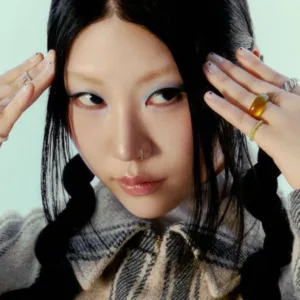


Heena Kim is an incredible jazz musician and she’s recently come out with her first album ‘The Poetry of Sound’. After the first listen we were completely blown away by the artistry, the vision and the vocals so we reached out with a couple of questions, which she happily answered.
‘The Poetry of Sound’ is a collection of tracks based on or inspired by Korean literature and poetry.
- You described the album as “a musical poetry book, written in the language of jazz, holding the sentiment of Korean literature, its love and its comfort.” What does the sentiment of Korean literature mean for you? How hard was it to portray that through your music?
“For me, the sentiment of Korean literature is about “Han (the uniquely Korean sense of deep sorrow and injustice),” a deep sense of longing, sorrow, and the way we choose to live while embracing those emotions.
It’s not simply about sadness or pain; it comes from a contemplative heart that accepts everything as part of life.
In Korean literature, I find a quiet beauty in the way it faces inevitable experiences—farewell, waiting, loss—without denial, and discovers something tender within them.
Expressing that sentiment through jazz was not easy.
Jazz is the language of freedom and improvisation, while Korean literature values restraint, silence, and the beauty of empty space.
So I tried to create a kind of breathing within the music—to let the message flow naturally, to allow emotions to move gently rather than be declared. The contemplative perspective found in Korean literature is, in a way, very close to jazz.
Jazz also embraces imperfection, unpredictability, and the emotions that arise in between.
Just as feelings shift between melancholy and warmth within improvisation, Korean literature holds a quiet courage to see life as it is—to accept and to simply be.
So in creating this album, I didn’t just want to turn poems into songs. I wanted to translate the spirit of acceptance—the heart that embraces life itself—into the language of jazz. And in many ways, that has become my own way of looking at life.”
- How did you come up with the idea to rework books and poetry into a jazz album?
“Actually, this idea grew very naturally within me over a long time. I have loved Korean literature for many years, and the delicate emotions and resonant phrasing in poetry and novels have always stayed with me.
I gradually felt that I didn’t want to stop at simply reading or appreciating them — I wanted to express that resonance through music.”
The selection process wasn’t easy according to Heena. Writers like Han Kang, Kim So-wol and poet Baek Seok were included but some of her other favorites weren’t. “Rather than feeling regret, it gave me hope that there is still room to continue exploring and expressing these works through music in the future. This album feels like a beginning — the first step in a long journey of connecting literature and jazz.”
Languages
On the album Heena sings in several languages, ranging from Korean to Spanish and French. I wondered if that it was a challenge to create an entire track in Spanish.
“Yes, it was definitely a challenge but at the same time, it felt like a very natural choice. The song ‘Llueve en mí’ was born from emotions that had stayed within me for a long time, and Spanish just felt like the language that could express them best.
Since the song is written in a bolero rhythm, I wanted to capture that particular warmth and depth that only the Spanish language can bring.
To do that, I actually took Spanish lessons and worked closely with a teacher to refine the pronunciation and nuances. I didn’t just want to speak the language correctly — I wanted to understand the emotion and the temperature that live inside the words. Every syllable in Spanish carries its own feeling, so to me, the language itself already sounded like music.
I also wrote the lyrics myself. It was my first time writing an entire song in Spanish, and even though it was difficult, I knew exactly what I wanted to say — a farewell to someone I had loved and carried in my heart for a long time. Because that message was so clear, the words and melody came together naturally.
In the end, this song went beyond the limits of language.
It became one of the most honest expressions of my emotions.
Even now, whenever I sing ‘Llueve en mí,’ I can still feel those same emotions come alive again.”
Producer credits
It was the first time she worked as a producer. “Until now, I had mainly focused on singing and expressing myself as a vocalist, but for this album, I took on the role of overseeing the music as a whole for the first time.
I was deeply involved in selecting the songs, arranging, guiding the recording process, and even participating in mixing and mastering, which allowed me to experience firsthand how a piece of music comes together from start to finish.
At first, it was quite daunting, but at the same time, it was an incredibly enjoyable process. Deciding how to convey the emotions and messages I wanted to express in the most honest way, and making musical choices myself, opened up a completely new perspective for me.
Through this process, I also learned many things I hadn’t known before, and my respect for the musicians and production team who quietly carry out these work behind the scenes grew even deeper.”
- You’ve worked with incredible musicians on this album. What is your favorite moment musically on the album? Is there one little section on a song that completely makes the track for you?
“Every moment on the album is precious, but a few particular scenes left a deep impression on me. In the title track ‘The Past Time’, the way each instrument interacts and builds upon one another is incredibly captivating.
In ‘Someday (먼 후일)’, the subtle tension and space created by our collective breathing is especially striking.
In ‘Unable to Forget (못잊어)’, whenever pianist GaYoung Bae’s solo comes in, the entire band becomes so absorbed that you can almost hold your breath.
And in ‘My Dear Poet’, it feels as if all the members are playing with one heart, making it one of the warmest and most joyful moments to listen to.”
“What I hope most is that listeners can take a moment to step away from their daily lives and face their own emotions.
Even amid the complexity of everyday life, I believe we can experience some of the deepest reflections of being human through literature and jazz.
I hope people will approach this album as they would a book of poetry on a quiet day — taking it out and immersing themselves in it.
The album carries a range of emotions — love, longing, loss, and comfort — and I hope that, in moments where these feelings intersect with their own lives, experiences, and memories, listeners can find even a small measure of solace.
Ultimately, this album is meant not only to convey my own story honestly but also to evoke in each listener their own stories and reflections on life.”
You can find Heena Kim on Instagram here.